CRSC questions and calculation

watchingpaintdry

PEB Forum Regular Member
Registered Member
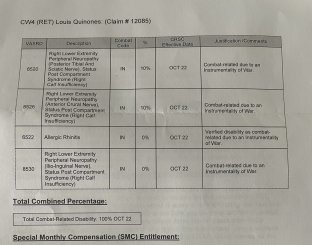
I recently got TDRL at 70% DOD and 90% VA. I was just looking for clarification on how CRSC would work given the following different circumstances with the understanding that these are estimates based on an expected retirement date and expected CRSC amount. The one question I have is if the CRSC percentage is based on only the total % amount of combat related conditions?

Currently Navy O4 retiring at 14 years 7 months on TDRL:

High 3=8341.31. Longevity at 14y7m=36.46%. Non blended.

VA 90% with spouse and 3 kids: 2666.39

Total non CRSC pay=8341.31x0.7=5838.92

With no CRSC, I should expect 2666.39 from the VA and 3172.53 (5838.92-2666.39) from DFAS for the total pay above correct?

Given the above and staying at 90% VA with 90% CRSC, my longevity would be 3041.24, which is more than the 90% VA. Would my CRSC be zero? Or would my total pay be longevity plus CRSC of 90% (3041.24+2666.39=5707.49)? Basically, is CRSC added on top of my 70% DOD pension or does CRSC automatically make it go to longevity pay plus CRSC? In that case, without CRSC +longevity, my 70% DOD would be slightly more (5838.92>5707.49).

Looking for the calculation with all the above information if I manage to get to 100% VA and stay at 90% CRSC in total pay per month.

I apologize if this is confusing, I’ve been reading this forum for hours and researching and I’m going numb now on exactly how CRSC works. To oversimplify, if you apply for CRSC as a Ch 61 TDRL, does your pension drop to longevity before you add CRSC? Thanks for bearing with me!
 
I recently got TDRL at 70% DOD and 90% VA. I was just looking for clarification on how CRSC would work given the following different circumstances with the understanding that these are estimates based on an expected retirement date and expected CRSC amount. The one question I have is if the CRSC percentage is based on only the total % amount of combat related conditions?

Currently Navy O4 retiring at 14 years 7 months on TDRL:

High 3=8341.31. Longevity at 14y7m=36.46%. Non blended.

VA 90% with spouse and 3 kids: 2666.39

Total non CRSC pay=8341.31x0.7=5838.92

With no CRSC, I should expect 2666.39 from the VA and 3172.53 (5838.92-2666.39) from DFAS for the total pay above correct?

Given the above and staying at 90% VA with 90% CRSC, my longevity would be 3041.24, which is more than the 90% VA. Would my CRSC be zero? Or would my total pay be longevity plus CRSC of 90% (3041.24+2666.39=5707.49)? Basically, is CRSC added on top of my 70% DOD pension or does CRSC automatically make it go to longevity pay plus CRSC? In that case, without CRSC +longevity, my 70% DOD would be slightly more (5838.92>5707.49).

Looking for the calculation with all the above information if I manage to get to 100% VA and stay at 90% CRSC in total pay per month.

I apologize if this is confusing, I’ve been reading this forum for hours and researching and I’m going numb now on exactly how CRSC works. To oversimplify, if you apply for CRSC as a Ch 61 TDRL, does your pension drop to longevity before you add CRSC? Thanks for bearing with me!
Right now you are correct. I just ran the numbers and no money for CRSC as your Chapter 61 pension is more than your earned longevity. See calculations below:

HIGH 3 PAY
8341​
DOD DISABILITY PERCENTAGE
70​
CRSC AWARD*(DOLLAR AMOUNT)
2047.06​
YEARSMONTHS
TIME OF SERVICE
14​
7​
MONTHLY V.A. PAY
2666.39​
CRSC PAY
0.00​
RESIDUAL RETIRED PAY
3172.31​
TOTAL FROM DFAS
3172.31​
Total Pay
5838.70​
 
Last edited:
I recently got TDRL at 70% DOD and 90% VA. I was just looking for clarification on how CRSC would work given the following different circumstances with the understanding that these are estimates based on an expected retirement date and expected CRSC amount. The one question I have is if the CRSC percentage is based on only the total % amount of combat related conditions?

Currently Navy O4 retiring at 14 years 7 months on TDRL:

High 3=8341.31. Longevity at 14y7m=36.46%. Non blended.

VA 90% with spouse and 3 kids: 2666.39

Total non CRSC pay=8341.31x0.7=5838.92

With no CRSC, I should expect 2666.39 from the VA and 3172.53 (5838.92-2666.39) from DFAS for the total pay above correct?

Given the above and staying at 90% VA with 90% CRSC, my longevity would be 3041.24, which is more than the 90% VA. Would my CRSC be zero? Or would my total pay be longevity plus CRSC of 90% (3041.24+2666.39=5707.49)? Basically, is CRSC added on top of my 70% DOD pension or does CRSC automatically make it go to longevity pay plus CRSC? In that case, without CRSC +longevity, my 70% DOD would be slightly more (5838.92>5707.49).

Looking for the calculation with all the above information if I manage to get to 100% VA and stay at 90% CRSC in total pay per month.

I apologize if this is confusing, I’ve been reading this forum for hours and researching and I’m going numb now on exactly how CRSC works. To oversimplify, if you apply for CRSC as a Ch 61 TDRL, does your pension drop to longevity before you add CRSC? Thanks for bearing with me!
Now if you get 100% VA and then get 70% for CRSC you will max out compensation and get an extra $1,374.75. So I would focus on getting 100% VA and showing TDRL conditions are stable so they can convert to PDRL.
HIGH 3 PAY
8341​
DOD DISABILITY PERCENTAGE
70​
CRSC AWARD*(DOLLAR AMOUNT)
2047.06​
YEARSMONTHS
TIME OF SERVICE
14​
7​
MONTHLY V.A. PAY
4172.46​
CRSC PAY
1374.75​
RESIDUAL RETIRED PAY
1666.24​
TOTAL FROM DFAS
3040.99​
Total Pay
7213.45​
 
Now if you get 100% VA and then get 70% for CRSC you will max out compensation and get an extra $1,374.75. So I would focus on getting 100% VA and showing TDRL conditions are stable so they can convert to PDRL.
HIGH 3 PAY
8341​
DOD DISABILITY PERCENTAGE
70​
CRSC AWARD*(DOLLAR AMOUNT)
2047.06​
YEARSMONTHS
TIME OF SERVICE
14​
7​
MONTHLY V.A. PAY
4172.46​
CRSC PAY
1374.75​
RESIDUAL RETIRED PAY
1666.24​
TOTAL FROM DFAS
3040.99​
Total Pay
7213.45​
Aim for 100% is my goal now. Thank you! With my current longevity, high 3, etc if I do get 100% VA would it matter if CRSC conditions were at 100% or would the numbers be the same with CRSC conditions only totaling 90%? I'd also get this while on TDRL right? I'd just want to make sure it stays that way through PDRL to make it permanent?
 
Aim for 100% is my goal now. Thank you! With my current longevity, high 3, etc if I do get 100% VA would it matter if CRSC conditions were at 100% or would the numbers be the same with CRSC conditions only totaling 90%? I'd also get this while on TDRL right? I'd just want to make sure it stays that way through PDRL to make it permanent?
CRSC is zero no matter what if approved and it has no bearing on the CRSC approval percentage. With 90% VA compensation and your earned longevity you are already getting max compensation by law. There are several ceilings for CRSC and that is one of them. CRSC is paid at same rate tables as VA tables. So basically you can look up what CRSC percentage will be higher than $1,374.75 to ensure you get max compensation from CRSC. None of that will matter if you don't get VA compensation to 100% because there is nothing to recoup at this time.
 
Special Rule for Chapter 61 Disability Retirees:

According to law, members retired for disability under Chapter 61 of title 10 United States Code must have the CRSC entitlement limited to an amount that when combined with any military retired pay remaining after offset for VA disability compensation will not exceed the retired pay they would otherwise be entitled to for retirement computed for years of service (i.e., 2 1/2 percent x active duty or active duty equivalent years of service x high three average base pay. Note: 2 percent is used for those enrolled in the Blended Retirement Program.)

Chapter 61 Disability Retirees:
Each CH 61 case involves these ceilings and other factors:

—Must be entitled to retired pay
—Agrees to waive retired pay in the amount of VA compensation received.
—CRSC cannot exceed the amount of the waived retired pay.
—CRSC cannot exceed the amount of the approved CRSC percentage (amt in VA Comp tables).
—CRSC cannot exceed the dollar amount of the longevity portion of retired pay.
—CRSC when combined with residual retired pay cannot exceed the longevity amount.

As one can see, more than one of the ceilings shown above could apply to the retiree. In those cases, the lesser amount is the CRSC amount.

Ron
 
IMG_5708.jpgIMG_5709.jpg

Without knowing your VA sheet, it is hard to guestimate what potential of CRSC you may get. My VA of 100% listed of what was combat related, service connected (including entries to burn pits (PACT ACT)). I was recently rated 100% CRSC as well but awaiting for the DFAS computation. In my case, my retirement is based on non-medical, longevity service. My suggestion Major is to work with a VSO after you receive VA compensation and then work your CRSC and if you want to increase your VA rating from there.
 
The above post will self destruct in 24 hours. :)
 
Right now you are correct. I just ran the numbers and no money for CRSC as your Chapter 61 pension is more than your earned longevity. See calculations below:

HIGH 3 PAY
8341​
DOD DISABILITY PERCENTAGE
70​
CRSC AWARD*(DOLLAR AMOUNT)
2047.06​
YEARSMONTHS
TIME OF SERVICE
14​
7​
MONTHLY V.A. PAY
2666.39​
CRSC PAY
0.00​
RESIDUAL RETIRED PAY
3172.31​
TOTAL FROM DFAS
3172.31​
Total Pay
5838.70​
How would he receive residual retired pay in his case if he did not complete 20 years AFS? Because of his 70% TRDL rating and since its higher than VA, he still eligible for it?
 
How would he receive residual retired pay in his case if he did not complete 20 years AFS? Because of his 70% TRDL rating and since its higher than VA, he still eligible for it?
@Provis is carrying the football on this case and doing a fine job.

Residual retired pay is not dependent upon a 20 year retirement.

Example using random numbers:

Sp4 DOE receives a disability retirement after five years AD.
His disability retired pay 3000.
His VA comp is 1200.
3000 minus 1200 = 1800 residual retired pay.

Ron
 
@Provis is carrying the football on this case and doing a fine job.

Residual retired pay is not dependent upon a 20 year retirement.

Example using random numbers:

Sp4 DOE receives a disability retirement after five years AD.
His disability retired pay 3000.
His VA comp is 1200.
3000 minus 1200 = 1800 residual retired pay.

Ron
That is why I am asking, to better understand. I know about the VA offset and aware if the offset is higher, than there is no residual pay correct? Usually, most cases, VA rating is 100% so many of the enlisted who are medically retired, their retired pay is less than their VA comp; hence 0 dollars from the DOD side. I failed to understand they could still receive DOD compensation if their VA is lower than the disability compensation. And the reason I ask is because I talk to many reservists/guardsman, vets and AD frequently that some are going through a med board and they bring up questions about compensation.
 
BTW, SP4 no longer exists. ;)
 
That is why I am asking, to better understand. I know about the VA offset and aware if the offset is higher, than there is no residual pay correct? Usually, most cases, VA rating is 100% so many of the enlisted who are medically retired, their retired pay is less than their VA comp; hence 0 dollars from the DOD side. I failed to understand they could still receive DOD compensation if their VA is lower than the disability compensation. And the reason I ask is because I talk to many reservists/guardsman, vets and AD frequently that some are going through a med board and they bring up questions about compensation.
1. I know about the VA offset and aware if the offset is higher, than there is no residual pay correct? CORRECT

2. And the reason I ask is because I talk to many reservists/guardsman, vets and AD frequently that some are going through a med board and they bring up questions about compensation. EXCELLENT

Ron
 
Helpful reference:

DOD 7000.14-R
Financial Management Regulation Volume 7B, Chapter 63

VOLUME 7B, CHAPTER 63: “COMBAT-RELATED SPECIAL COMPENSATION”

Ron
 
Did it become “Specialist” without the 4?

Ron
I was joshing you but yes. But when I came in, I remember seeing a Spec 5 rank. Also, as a former Marine, that you move from Lance Corporal to Corporal and have to run as an NCO immediately, I always advocated for the Army corporal rank to become more prominent and it has in the last few years when the Army made changes about the Corporal rank.
 
I was joshing you but yes. But when I came in, I remember seeing a Spec 5 rank. Also, as a former Marine, that you move from Lance Corporal to Corporal and have to run as an NCO immediately, I always advocated for the Army corporal rank to become more prominent and it has in the last few years when the Army made changes about the Corporal rank.
Yes, the SP5 rank was commonplace during much of my career. I think it was eliminated sometime between 1979 - 1984 when I was in Schweinfurt Germany. Everyone seemed glad to see it go.

The first time I was in the Army, 1966-1968, there was a barracks sergeant who wore the stripes of a sergeant first class, but was paid at the SSG E6 rate. He was a holdover from the Army changes in the 1950s when they added the “super grades.”

From an Internet source:
In an attempt to reduce costs in June 1920, Congress eliminated the position of sergeant major by grouping enlisted members into seven pay grades (E-1 through E7). The senior noncommissioned officer in an organization for the next thirty-eight years was the senior master sergeant.12 But throughout this period the conditions of the enlisted man’s career choices were brought to light, first by the 1953 Womble Board, then later the Cordiner Committee. Rear Admiral J.P. Womble’s group studied, among other things, the problem of enhancing the noncommissioned officer’s status and prestige. But, it was five more years until the Defense Advisory Committee on Professional and Technical Compensation, chaired by Ralph J. Cordiner, caused any change.

They developed the Military Pay Bill of 1958, which recommended establishing two new enlisted pay grades E-8 and E-9, the “supergrades.” In April 1959, the first NCOs were promoted into the newly created rank. But with the creation of the new grades, the question arose of how to address these individuals. Finally, in 1962 Army Chief of Staff General George H. Decker decided that in the tradition of the British Army, the most senior noncommissioned officer would be addressed as “sergeant major”

Ron
 
Last edited:
Maybe this is common knowledge, but I was struggling to find it. For the high 3 calculation is it actual earnings or highest pay grade over a 3 year period? As an example my "highest 3" would be during a period where I waved pay for VA. And a similar question - Will the "high 3" use a pay grade and year if drilling for points only?


Thanks,

Dave
 
Maybe this is common knowledge, but I was struggling to find it. For the high 3 calculation is it actual earnings or highest pay grade over a 3 year period? As an example my "highest 3" would be during a period where I waved pay for VA. And a similar question - Will the "high 3" use a pay grade and year if drilling for points only?


Thanks,

Dave
Hello @DaveK

Reference: DoD 7000.14-R Financial Management Regulation Volume 7B, Chapter 3
Table of Contents
VOLUME 7B, CHAPTER 3: “GROSS PAY COMPUTATION”

2.1.1. Retired Pay Base. The retired pay base is determined by using the active duty basic pay entitlement of the member.
2.1.1.1. Pre-September 8, 1980 Member. For individuals who first became members before September 8, 1980, the retired or retainer pay base is the basic pay of the member on the day before retirement. See paragraphs 2.2 through 2.6 for exceptions.
2.1.1.2. Post-September 7, 1980 Member. For individuals who first became members after September 7, 1980, the retired or retainer pay base is the average of the highest 36 months of basic pay received.
2BDoD 7000.14-R Financial Management Regulation Volume 7B, Chapter 3
3-5
2.1.1.2.1. The retired pay base for a member with 36 or more months of active service is the average monthly basic pay the member received over their highest earning 36 months. In the case of a Reserve component member, this is the total amount of basic pay to which the member was entitled during the member’s high 36 months or to which the member would have been entitled if the member had served on “active duty” during the entire period of the member or former member’s high 36 months. Only months during which the individual was a member of a uniformed service may be used. Starting with the highest rate of pay, add together the monthly basic pay amounts until the total number of months equals 36 months. Divide the total pay derived from the sum of months by 36, and round to the nearest cent to obtain the retired pay base applicable to the member. Any lost time the member had is not to be included in the computation.

2.1.1.2.2. The retired pay base for a member with less than 36 months of active service is the member’s basic pay for the entire period of the member’s active service added together divided by the number of months (including any fractions thereof) of the member’s active service. In the case of a Reserve component member, this is the total amount of basic pay to which the member was entitled or to which the member would have been entitled if the member had served on active duty during the entire period before being retired. Divide the total pay by the total time expressed as months and days, count days that are less than 30 as 1/30th of a month. Round the result to the nearest cent.

--------------
Various scenarios can be found in the same Chapter at:
https://www.google.com/url?sa=t&rct...b/07b_03.pdf&usg=AOvVaw02JT0cQlIGmLPu9hb3uUVf <---LINK

LINK

Ron
 
Always on it Mr. Ron. Thank you so much. I just got 5 packets turned in with over 150 pages for IDES/retirement. 3 more to go. This info just takes one more issue off my mind. Your time is really appreciated.
 
Top