CRSC vs CRDP calculation, non-medical retiree, 32 years in service

IMG_5840.jpg


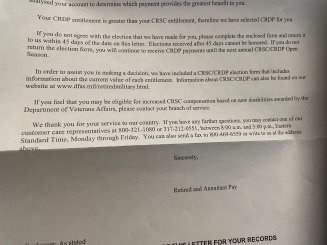
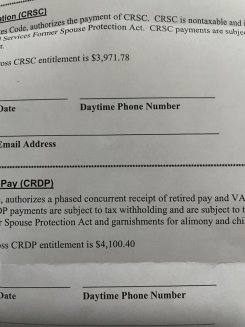
Ok, I received this letter yesterday. And it shows that CRDP is the better option but since my DOD retirment is at 5100 and it shows CRDP at 4100. What does it mean if I switch to CRSC? I will only receive my VA of 4100 and just 3971 CRSC? what happens to the 5100 - 3971 =1129? That amount completely goes away? Or is that residual amount that is taxable? I ask because it does not show that when it comes to those that their retired pay is more than their VA pay? I called DFAS and the woman sounded confused and suggested that I will get the difference but did not sound sure. Another person said, I just get the 3971. I just want to go with the selection that is optimal for tax purposes. I still work full-time as well as my spouse.

Thank you.
 

Attachments

  • IMG_5841.jpg
    IMG_5841.jpg
    463.3 KB · Views: 6
Hello @ArmyChiefTech

Background: I see many cases and they seem to blend together (for me), but from scanning thru the discussions within this thread, it appears you have a regular retirement (not reserve/NG nonregular nor CH 61 disability retirement). I infer your approved CRSC is at 100% and your VA comp is also at 100%.

CRDP with regular retirement: You would receive all your retired pay and all your VA compensation. The CRDP amount on page 2 of the RAS should be the amount of the VA offset.
CRDP is retired pay itself. The gross on your DFAS RAS under the CRDP scenario should be the CRDP amount plus the amount that would have been in excess of the VA offset IF the offset had been applied.

CRSC with regular retirement: Your retired pay will be reduced dollar for dollar in the amount of VA compensation received.
Any amount in excess of the reduction/waiver/offset is residual retired pay and that will paid on a DFAS RAS to you.
The 100% CRSC in your case based on the info provided should the same amount of the VA offset. It will be paid/shown on a CRSC statement. You also receive the VA ciomp.

Part of this explanation is based on my experience working with CRDP when the retired pay was actually reduced by the amount of VA comp. That ended several years ago.

Ron
cc: @Provis

Edited to add: Once you make your decision, you will not be able to change it until open season, next January. I recommend you confirm whether the process described above will be what DFAS implements.

I am not infallible, so confirmation by DFAS is advised.
 
Hello @ArmyChiefTech

Background: I see many cases and they seem to blend together (for me), but from scanning thru the discussions within this thread, it appears you have a regular retirement (not reserve/NG nonregular nor CH 61 disability retirement). I infer your approved CRSC is at 100% and your VA comp is also at 100%.

CRDP with regular retirement: You would receive all your retired pay and all your VA compensation. The CRDP amount on page 2 of the RAS should be the amount of the VA offset.
CRDP is retired pay itself. The gross on your DFAS RAS under the CRDP scenario should be the CRDP amount plus the amount that would have been in excess of the VA offset IF the offset had been applied.

CRSC with regular retirement: Your retired pay will be reduced dollar for dollar in the amount of VA compensation received.
Any amount in excess of the reduction/waiver/offset is residual retired pay and that will paid on a DFAS RAS to you.
The 100% CRSC in your case based on the info provided should the same amount of the VA offset. It will be paid/shown on a CRSC statement. You also receive the VA ciomp.

Part of this explanation is based on my experience working with CRDP when the retired pay was actually reduced by the amount of VA comp. That ended several years ago.

Ron
cc: @Provis

Edited to add: Once you make your decision, you will not be able to change it until open season, next January. I recommend you confirm whether the process described above will be what DFAS implements. You will probably have to ask for someone in the CRDP/CRSC section to get an accurate answer. Over the years, I have explained to DFAS how their computation of my CRDP or CRSC was incorrect. The last time, i had to resort to writing a letter to the Direcctor of DFAS-Cleveland, who is now retired. Although he used to "work for me" in a finance office in Germany (he was a SSG E6 at the time and I was a SGM E9), we are not buddies. He directed the repair because it was warranted.

I am not infallible, so confirmation by DFAS is advised.

Yes, I am 100% VA and CRSC. My DOD pension is 5100 a month and with SBP, Tricare Select and Fed Taxes, I usually receive 4200 a month (if that is the single rate). The married rate, I clear 4500. Yes, on my current RAS, it shows the CRDP at 4100.04 as in the screenshot above. But my question from what I read from that letter, if I select CRSC, its just 3971 CRSC and VA 4100? my DOD retirement that was 5100 is now just reduced to 3971 CRSC?
 
Yes, I am 100% VA and CRSC. My DOD pension is 5100 a month and with SBP, Tricare Select and Fed Taxes, I usually receive 4200 a month (if that is the single rate). The married rate, I clear 4500. Yes, on my current RAS, it shows the CRDP at 4100.04 as in the screenshot above. But my question from what I read from that letter, if I select CRSC, its just 3971 CRSC and VA 4100? my DOD retirement that was 5100 is now just reduced to 3971 CRSC?
My guess is that even though you are 100% VA and 100 CRSC there were some income that wasn't counted towards CRSC. This can happen when you get aid and attendance or SMC for a non CRSC condition. If that is the case DFAS will say that CRDP is higher and that it will choose CRDP for you if you do nothing. Now depending on the difference it may be worth getting CRSC at a lower amount due to CRSC being tax exempt.

Just a theory but something you may want to look into. I know when my wife was approved for CRSC it stated that a SMC item was not approved for CRSC making her VA compensation greater than the CRSC amount.
 
Yes, I am 100% VA and CRSC. My DOD pension is 5100 a month and with SBP, Tricare Select and Fed Taxes, I usually receive 4200 a month (if that is the single rate). The married rate, I clear 4500. Yes, on my current RAS, it shows the CRDP at 4100.04 as in the screenshot above. But my question from what I read from that letter, if I select CRSC, its just 3971 CRSC and VA 4100? my DOD retirement that was 5100 is now just reduced to 3971 CRSC?
I mentioned: "CRSC with regular retirement: Your retired pay will be reduced dollar for dollar in the amount of VA compensation received.
Any amount in excess of the reduction/waiver/offset is residual retired pay and that will paid on a DFAS RAS to you.
The 100% CRSC in your case based on the info provided should the same amount of the VA offset. It will be paid/shown on a CRSC statement. You also receive the VA comp.'
SUMMARY: Three payments are involved: two by DFAS and one from the VA.

Also mentioned: "CRDP with regular retirement: You would receive all your retired pay and all your VA compensation. The CRDP amount on page 2 of the RAS should be the amount of the VA offset. CRDP is retired pay itself. The gross on your DFAS RAS under the CRDP scenario should be the CRDP amount plus the amount that would have been in excess of the VA offset IF the offset had been applied. SUMMARY: One payment from DFAS (CRDP and residual Ret Pay combined) One pmt from VA.

Ron
 
Just a theory but something you may want to look into. I know when my wife was approved for CRSC it stated that a SMC item was not approved for CRSC making her VA compensation greater than the CRSC amount.
Excellent.

Ron
 
My guess is that even though you are 100% VA and 100 CRSC there were some income that wasn't counted towards CRSC. This can happen when you get aid and attendance or SMC for a non CRSC condition. If that is the case DFAS will say that CRDP is higher and that it will choose CRDP for you if you do nothing. Now depending on the difference it may be worth getting CRSC at a lower amount due to CRSC being tax exempt.

Just a theory but something you may want to look into. I know when my wife was approved for CRSC it stated that a SMC item was not approved for CRSC making her VA compensation greater than the CRSC amount.
I think the difference between the two is that the CRSC does not include the ED that is under my VA SMC. Well, I can submit and gauge CRSC payments this year. And then switch back to when open season happens to see if the tax situation (in which I owe vs refund) is for year 2024. I just hope my civilian job doesnt lay me off during that period lol.
 
I think the difference between the two is that the CRSC does not include the ED that is under my VA SMC. Well, I can submit and gauge CRSC payments this year. And then switch back to when open season happens to see if the tax situation (in which I owe vs refund) is for year 2024. I just hope my civilian job doesnt lay me off during that period lol.
You can do nothing if you are okay with CRDP. When you have both CRDP and CRSC you are splitting hairs especially if you are in a lower tax bracket.
 
You can do nothing if you are okay with CRDP. When you have both CRDP and CRSC you are splitting hairs especially if you are in a lower tax bracket.
Good point in this situation since his CRSC is 100% (although as you expertly determined, the SMC might not be included).

I once chose CRSC over CRDP even though it it a couple of hundred dollars less—for the tax benefit since I had other taxable income besides retired pay. My CRSC rating at the time was not 100%.

I computed my “would be taxes” and found that my overall net (because of less taxable income ) was more even though I chose the lesser, CRSC.

Ron
 
The convoluted history of the implementation of CRDP.

Concurrent Retirement and Disability Payment (CRDP):​

This program provides a 10-year phase-out of the offset to military retired pay due to receipt of VA disability compensation. Qualified individuals are those who are retired active or age 60 retired reserve members who also have a combined VA disability rating of 50% or greater. Members retired under military disability provisions (Chapter 61 to title 10 United States Code) must have at least 20 years of service. Today, more than 310,000 retirees are receiving CRDP payments of over $427 million per month.

Effective January 1, 2004: Initial entitlement under the program began on January 1, 2004. Payments were made to nearly 150,000 qualified retirees on February 2, 2004.

Effective January 1, 2005: The 10-year phase-out was eliminated for those individuals actually rated 100% disabled by the VA and they became eligible to receive all of their formerly offset military retired pay.

Effective October 1, 2008: The 10-year phase-out was eliminated for those individuals not rated 100% disabled by VA, but who are paid at the 100% level as "Individual Unemployables" (IUs), and they become eligible to receive all of their formerly offset military retired pay retroactive to January 1, 2005.

Initial Rates: CRDP is part of retired pay and cannot exceed the amount that would be otherwise offset. During CY 2004, CRDP was paid to qualified retirees up to the following maximum amount based on the current monthly VA disability rating:

VA Disability RatingInitial CRDP Payment in CY 2004
100% (total)$750
90%$500
80%$350
70%$250
60%$125
50%$100

Phase Out: The above payments are increased each year following 2004, by additionally paying a percentage of the remaining amount of retired pay still being offset for each individual until the offset is completely eliminated in 2014. Therefore, the phase out is progressive. This results in the following schedule of payments:

Calendar YearPercentage of Remaining Offset (if any) to be Added to Initial CRDP
200510.00%
200628.00%
200749.60%
200869.76%
200984.88%
201093.95%
201198.18%
201299.64%
201399.96%


Ron
 
Top